
The challenge is bigger than security
Enterprise data is not uniform. Contracts, HR information, technical documents, customer records and strategic knowledge do not carry the same risk. AI adds a new layer: users can paste sensitive content, agents can combine sources, and generated answers can reveal relationships that were never meant to be exposed.
This makes AI governance more concrete than traditional security policies. A company may have clean SharePoint permissions, a serious directory and a GDPR policy, while still letting AI create new paths for leakage. As soon as a model is connected to internal documents, the operational questions become unavoidable: who may ask what, under which traceability rules, and with what audit trail if an answer is challenged?
Standards are starting to frame the issue
ISO/IEC 42001 defines requirements for establishing, maintaining and improving an AI management system. It is not only a technical checklist; it formalizes policies, roles, risk evaluation, lifecycle management and continuous improvement around AI systems.
ISO/IEC 42001 reminds companies that AI is not just a software component. It becomes a socio-technical system involving data choices, models, infrastructure, human validation and ongoing supervision. For an SME, the value of such a framework is not to add bureaucracy, but to make decisions explicit before usage becomes impossible to control.
ISO 27001 remains relevant for information security, but AI adds questions around data quality, outputs, human oversight, model selection and supplier control.
What AI governance must decide
In practice, AI governance has to decide which data may be used for each use case, which AI tools are approved, which logs are retained, how access rights are enforced inside RAG, who validates model changes and how a disputed answer can be audited after the fact.
A useful policy must also distinguish use cases. A public writing assistant, an internal search engine, a code copilot and an agent able to call tools do not carry the same level of risk. The closer AI gets to data and processes, the more the company needs traceability, access limits and controlled architecture.
How OPA helps
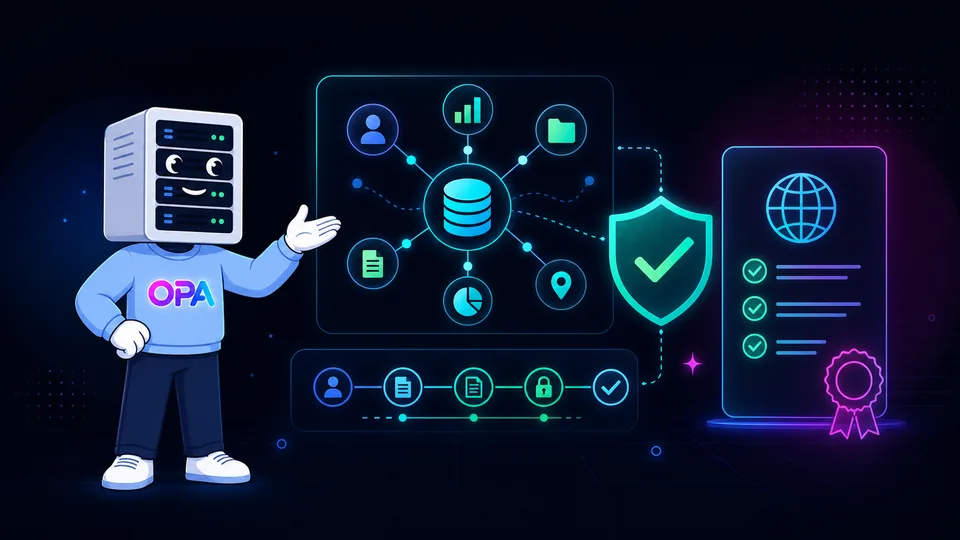
OPA does not replace governance; it gives governance a controllable technical base. By hosting inference, RAG and document flows on private infrastructure, companies can apply access rules, reduce data exposure, trace usage and avoid scattered personal tools or unmanaged APIs.
For an SME, this approach makes governance more realistic. Instead of multiplying personal accounts, isolated experiments and integrations that are difficult to follow, the company can create a shared foundation: identified models, a private document base, controlled logs and an access policy aligned with the organization. AI then becomes governable infrastructure rather than a collection of dispersed tools.
Conclusion
AI data governance is becoming structural. Standards such as ISO/IEC 42001 show the direction: AI must be managed, documented and controlled. OPA provides the local infrastructure to make that control practical.
Discuss AI governanceSources: ISO/IEC 42001, AWS Security Blog on ISO/IEC 42001, Microsoft Learn ISO/IEC 42001.
Tom Cheniaux - rephrased using AI