
AI has become a habit
In just a few years, generative artificial intelligence has moved from a technological curiosity to a working reflex. Drafting a letter, summarising a contract, translating a datasheet, debugging a script, preparing a meeting or querying a document base: these actions are now performed with a model, almost without thinking. The habit is no longer confined to the office; it has settled into private life too, for homework, finding a recipe or planning a trip. This very ordinariness is what gives providers such a comfortable position: a tool used every day becomes a tool you depend on.
For an SME, that dependency is rarely a decision. It builds up from the bottom, subscription after subscription, personal account after personal account, until one day part of the daily work relies on an outside service whose price, limits and availability the company does not control. It is precisely when the habit becomes structural that the economics behind it deserve a cold, hard look.
Quotas are tightening
The first signal is already visible: usage limits are getting stricter. In July 2025, Anthropic announced weekly quotas for Claude subscribers, on top of the existing five-hour windows, effective at the end of August. Officially this was to curb a minority of heavy users; in practice, a paid subscription became more tightly capped than before, with the option to "buy back" extra usage at API rates once the quota is reached. Even the most expensive plan is no longer presented as unlimited, but as a multiple of a base plan.
The same movement is visible elsewhere: messages counted per window, access to the best models reserved for higher tiers, advanced features pushed toward "enterprise" offers. The pattern is consistent. You do not abruptly withdraw a service that has become part of daily life; you quietly reduce its generosity, you make the free or cheap tier just frustrating enough, and you move the real value toward pricier subscriptions. For the user, the tool has not changed its name, but it gives a little less for the same price.
The sticker price does not cover the real cost
The underlying reason is simple: today's prices do not reflect the cost of production. In January 2025, OpenAI's leader publicly admitted to losing money on the $200-per-month ChatGPT Pro plan, because customers were using it far more than expected. He noted that he had set the price himself, thinking he would "make some money." As for the $20 consumer plan, he explained elsewhere that he had chosen it without any rigorous pricing study, simply by comparing two prices. In other words, the subscriptions that individuals and SMEs pay for today were never calibrated to be profitable; they were calibrated to win the market.
It is worth weighing what that implies. When a sector leader's most expensive service loses money at $200 a month, the $20 plan that equips most professionals is, by construction, sold below cost. This is not a passing anomaly: it is the model itself. Inference is expensive in compute, GPUs and energy, and every additional request widens the gap. Such a gap can only hold as long as outside funding fills it.
Extraordinary investments to amortise
And that funding is on a staggering scale. For 2026 alone, the four main hyperscalers — Amazon, Microsoft, Alphabet and Meta — plan to spend close to $700 billion on infrastructure, up roughly 60% from 2025. OpenAI, for its part, presented investors with a trajectory of negative free cash flow of around $278 billion between 2026 and 2030, with break-even only hoped for around 2030 and operating losses still rising until then. These are not the numbers of a mature market optimising margins; they are the numbers of a capacity race financed on credit against the promise of future revenue.
Such a level of investment must, one day, be amortised. The shareholders and lenders funding these data centers will not indefinitely accept selling at a loss a service used weekly by hundreds of millions of people. Mechanically, there are only three outcomes: give less for the same price, raise prices, or both. The tightening quotas already on display are not a housekeeping detail; they are the first visible sign of an equation that must eventually rebalance.
Make yourself indispensable, then present the bill
There remains a more strategic reading, and probably the most worrying one for a business. Selling at a loss during the land-grab phase is not necessarily a mistake: it is a proven method. You build the habit, you become indispensable, you let business processes rebuild themselves around the tool — then, once the dependency is set, you present the bill at a price the market has become unable to refuse. The software and cloud world has already seen this cycle: services that are generous at first, then gradually more restrictive and more expensive, once users are captive.
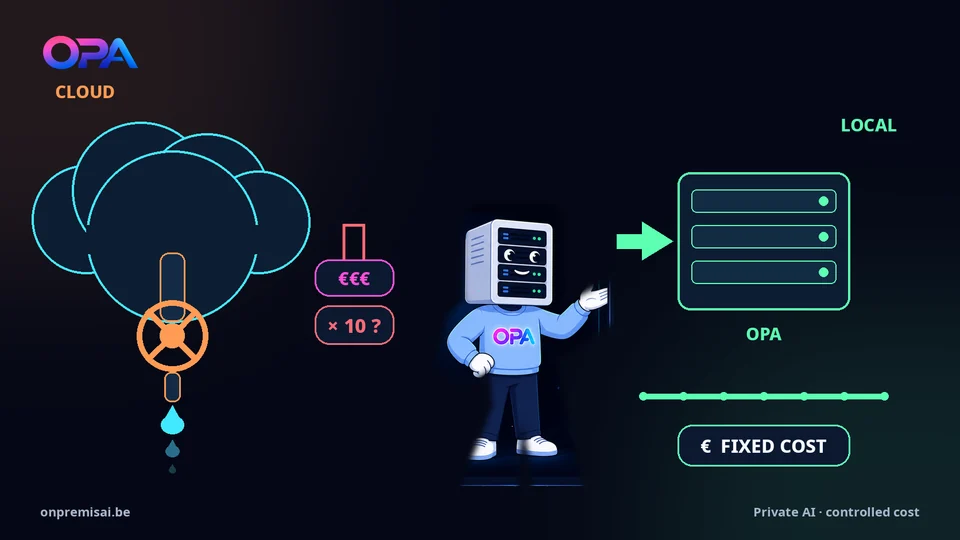
Nothing guarantees that prices will be multiplied by ten within months or years. But the trajectory makes the hypothesis credible: real costs far above sticker prices, colossal investments to recoup, and usage so thoroughly daily that a sharp increase would meet little resistance. A company that has let AI seep into its operations without a fallback plan would then face a choice it never made: pay the new price, whatever it is, or disorganise its work overnight.
Take back control before the valves close
This is exactly where a private AI infrastructure earns its place. OPA does not claim that local AI is free: it has a hardware and energy cost. But that cost is known, fixed and controlled. Open-weight models, installed on a dedicated server with a private document-retrieval engine, turn a variable, uncontrollable expense into a budgetarily stable capacity. Above all, they make the company independent of a quota, a price grid or a commercial decision taken elsewhere.
The right approach is not to pit cloud against local head-on, but to keep the freedom to choose. Some occasional or highly specialised workloads will remain relevant in the cloud; others — recurring, sensitive or critical — are better run on infrastructure you own. Anticipating the closing of the valves does not mean giving up on AI: it means making sure that the day prices finally reflect the real cost, you are the one deciding what you pay.
Conclusion
Today's AI prices are land-grab prices, not equilibrium prices. OPA positions itself as a solution for mastering AI: a private, controllable capacity, independent of provider quotas, that helps businesses regain control of their use and secure their digital future. Keeping part of your AI on private infrastructure means keeping the choice on the day the giants close the valves.
Assess a cost-controlled private AISources: TechCrunch — OpenAI is losing money on ChatGPT Pro, TechCrunch — Anthropic introduces weekly rate limits on Claude, Reuters — OpenAI expects to burn nearly $280 billion by 2030, CNBC — Nearly $700 billion of hyperscaler AI spending in 2026.
Tom Cheniaux - rephrased using AI