The scenario nobody plans for
A feature embedded in a daily process quickly stops being a convenience. Prompts are validated, automations are built around it, output formats become conventions and users change their habits. At that point, the external service has become an operational dependency, even if nobody formally declared it as one.
In 2026, several decisions by major providers showed how quickly that dependency can materialise. The issue is not merely that an interface changes. The business must absorb, on a timetable it did not choose, a new licence, a new model or a new workflow.
Three recent signals
Microsoft announced on March 27, 2026 that Copilot Chat would be removed from Word, Excel, PowerPoint and OneNote for part of the organisations using the basic offer, effective April 15. Copilot Chat remains available elsewhere, including Outlook and the Microsoft 365 Copilot app, but direct integration in the affected Office applications then requires a Microsoft 365 Copilot licence. For administrators whose teams had already incorporated the feature into daily work, the notice period was measured in weeks.
OpenAI removed GPT-4o, GPT-4.1, GPT-4.1 mini and o4-mini from ChatGPT on February 13, 2026. Business, Enterprise and Edu customers received an additional transition period for GPT-4o in custom GPTs until April 3, after which those GPTs were automatically moved to replacement models. The episode is especially telling because an earlier GPT-4o removal during the GPT-5 launch in 2025 had already been partly reversed following user feedback.
The pattern extends beyond AI. Salesforce is transitioning its legacy Live Agent product towards Messaging, while Atlassian previously restored a Bitbucket Cloud feature after acknowledging that it was integral to customer workflows. With installed software, a company can sometimes postpone an update. With SaaS, it usually cannot.
What actually breaks inside the business
The first impact is visible: procedures and automations stop behaving as expected. The second is quieter. A model replaced by “the closest equivalent” does not necessarily produce the same classifications, extractions or wording. Previously validated prompts may change behaviour without an explicit error. In a business process, this silent regression can be harder to detect than an outage.
Traceability also becomes fragile. Documenting an AI system for GDPR, the AI Act or a quality process means knowing which model is involved, how it is configured and when it changes. When the provider can alter that layer without prior approval, the technical file soon describes a system that no longer exists in exactly the same form. Budget and timing follow the same pattern: an included capability can become paid, and the migration calendar remains the vendor’s.
It is not malice; it is the business model
Large vendors do not remove features to harm customers. They simplify complex product ranges, reduce infrastructure costs, move value towards higher licence tiers and focus teams on the products they want to develop. From their point of view, those decisions are rational.
The misalignment is structural: their roadmap is not yours. Renting a capability also means accepting that its owner may modify, rename, limit, repackage or remove it. A contract can frame some commitments, but it does not turn a rented service into owned capacity.
Reduce dependency before it becomes critical
The first step is to inventory the actual dependencies: which process relies on which tool, feature and model, with which data and what consequence if it changes? This separates experimentation, which can tolerate rapid evolution, from the uses that genuinely keep the business running.
The second step is to place a stable layer between internal applications and providers. An OpenAI-compatible gateway allows tools to talk to an internal contract rather than a specific model. The model becomes replaceable configuration instead of a dependency scattered across every application. This architecture does not eliminate migrations, but it makes them deliberate and testable.
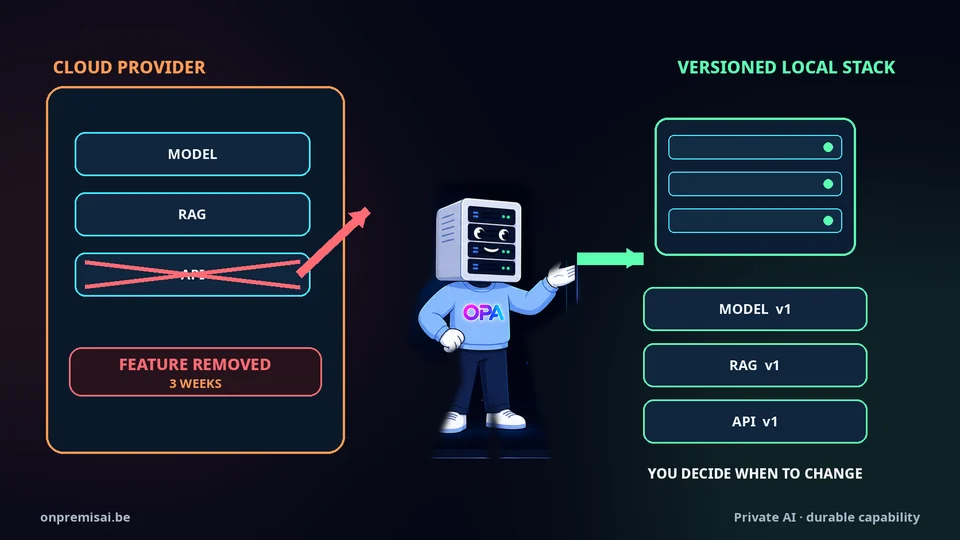
For critical functions, versioning and regression tests are essential. An open-weight model can be downloaded, retained and run in the same version. A reference prompt set can then compare a candidate before migration: same documents, same questions and explicit business criteria. The company chooses when to change instead of discovering the consequences after the switch.
The OPA approach
With an on-premise AI server, the model, data and access layer remain under the company’s control. A version that works today can keep working tomorrow; a new model is evaluated before it is promoted. Cloud services remain valuable for exploration, capacity peaks or specialised functions, but they no longer constitute the single point on which the critical process depends.
OPA assembles this capability around an open stack: local inference engines, private RAG, assistants and agents, with an OpenAI-compatible gateway to minimise changes in existing tools. The goal is not to promise that infrastructure will never change. It is to make change explicit, versioned and decided by the company.
Map your AI dependencies
Which parts of your activity currently depend on a provider that can change the rules tomorrow? We can inventory them, separate exploratory from critical use and define a reversible architecture.
Let's talk about itSources: OpenAI — Retiring GPT-4o and other ChatGPT models, Microsoft Tech Community — Removal of Copilot Chat in Microsoft 365 apps, Salesforce Developers — Migrating Live Agent to Messaging, Atlassian Community — Bitbucket Cloud feature removal rollback.
Tom Cheniaux - rephrased using AI